
Islands in Balance: Tourism, Energy, and Community Futures Discussed on Kythira
Alexis Chatzimpiros
What brings rural areas together? Can tourism be managed within clear limits to protect landscapes and local resources while still supporting economic vitality? And could clean energy become a new driver for sustainable local development? These were some of the key questions explored at an international conference on tourism and infrastructure capacity, held on the rural island of Kythira, Greece, on 16–17 October 2025.
Kythira faces challenges familiar to many rural and island communities across Europe. Much of the island’s land is commonage, collectively owned by the local community. While large areas were previously leased and actively cultivated, many have remained unused for decades. At the same time, depopulation and the decline of primary sector activities have reshaped the local economy, with summer tourism emerging as the main driver of development. This seasonal pressure places increasing strain on local infrastructure and natural resources. Although the commonage is largely managed according to a strong preservation principle, this approach also limits opportunities for locally driven development.
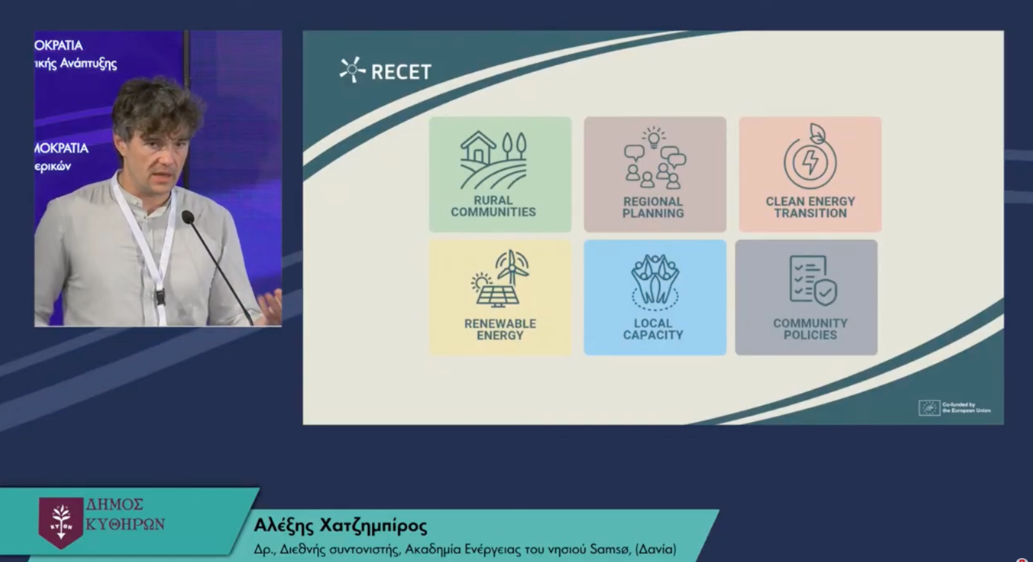
Against this backdrop, the conference provided a valuable platform for dialogue between researchers, policymakers, practitioners, and local stakeholders. Among the speakers was Alexis Chatzimpiros from the Samsø Energy Academy, who presented the experience of the Danish island of Samsø and discussed insights from the RECET project. His presentation highlighted how clean energy initiatives, when designed inclusively, can strengthen rural communities rather than compete with landscape protection.
Key elements emphasized included inclusive energy planning, meaningful public participation, and the creation of tangible local benefits. These factors, he argued, are essential for fostering community engagement and long-term support for the clean energy transition in rural areas. In addition to his presentation, Alexis Chatzimpiros held bilateral meetings with conference participants and local stakeholders interested in learning from experiences in other rural regions. Discussions focused on how renewable energy solutions can be integrated in ways that respect local contexts while contributing to economic resilience.
Knowledge exchange, capacity building, and cooperation between islands and remote rural areas emerged as central themes throughout the conference. Participants highlighted the value of sharing practical examples and transferable lessons that can be adapted to different geographical, social, and governance settings. Lessons from the RECET project will be shared with the municipality of Kythira, the conference’s scientific committee, local community representatives, and other participants, supporting continued dialogue on how rural areas can balance preservation, tourism, and sustainable development.